Test-Optional Is No Longer Optional: What Families Need to Know About College Admissions Today
Test-Optional Is No Longer Optional: What Families Need to Know About College Admissions Today
For the past several years, families have heard a reassuring message from colleges: “Test scores are optional.”
For many students, this felt like a welcome relief—one less pressure point in an already stressful admissions process.
But as we move deeper into the current admissions landscape, one thing has become increasingly clear:
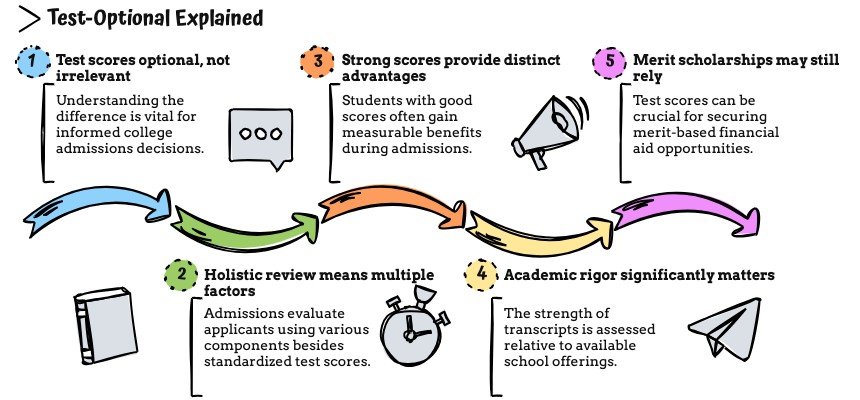
Test-optional does not mean test-irrelevant.
In fact, today’s college admissions environment is best described as test-strategic, not test-optional. Families who understand this distinction—and plan accordingly—are far better positioned to make confident, informed decisions that protect both opportunity and affordability.
At Stepping Stones College Educational Advisors, we work closely with students and parents to navigate this nuance. In this article, we’ll explain what test-optional really means today, how admissions officers are evaluating applications without scores, and how families can make strategic testing decisions that support—not sabotage—a student’s college outcomes.
The Evolution of Test-Optional Policies
Test-optional policies expanded rapidly during the pandemic, when access to SAT and ACT testing was inconsistent and inequitable. Colleges adapted quickly, removing standardized test requirements to ensure fairness and access.
Several years later, many families assume that standardized testing no longer matters at all. However, admissions offices have now had multiple full cycles of data to analyze, and the results have been eye-opening.
While most colleges remain officially test-optional, many have quietly recalibrated how they evaluate applications—especially at selective institutions.
In short:
Students are not penalized for applying without scores
But students with strong scores often gain a measurable advantage
Understanding when and how that advantage applies is the key to making smart decisions.
What “Holistic Review” Really Means in a Test-Optional World
Colleges frequently use the term holistic review, but for families, this phrase can feel vague or even misleading.
In practice, holistic review means that admissions officers evaluate students using multiple data points, including:
Academic rigor and grades
Course trajectory over time
School context and availability of advanced coursework
Essays and written expression
Activities, leadership, and engagement
Letters of recommendation
And—when submitted—standardized test scores
When test scores are absent, other components must do more work to demonstrate readiness.
This is where many families are caught off guard.
Without test scores, admissions officers lean more heavily on:
Transcript strength relative to school offerings
Consistency across academic subjects
Writing quality and intellectual curiosity
Evidence of initiative and sustained commitment
For some students, this works beautifully. For others—particularly those from highly competitive high schools—it can make differentiation more difficult.
Why Strong Test Scores Still Matter (Even When They’re Optional)
While colleges may not require test scores, many still rely on them internally for several important reasons:
1. Academic Confidence
Test scores provide a standardized data point that helps admissions officers compare students across different schools, grading systems, and regions.
2. Merit Scholarships
At many institutions, test scores still play a significant role in merit-based aid decisions, even when admissions is test-optional. Families often don’t realize that opting out of score submission can limit scholarship eligibility.
3. Institutional Reporting
Colleges continue to report test score ranges for rankings and internal benchmarking. Students with high scores can help institutions meet institutional goals—making those applicants particularly attractive.
4. High-Volume Application Pools
With record-breaking application numbers, admissions officers are looking for efficient ways to assess academic readiness. Strong scores can provide clarity in crowded applicant pools.
The takeaway: Test scores are no longer a gatekeeper—but they can still be a lever.
When Students Should Submit Test Scores
At Stepping Stones College Educational Advisors, we emphasize strategy over rules. There is no universal answer—but there are guiding principles.
Students should strongly consider submitting scores if:
Their scores fall within or above the college’s middle 50% range
Their GPA is strong but comes from a highly competitive or deflated grading environment
They are applying to competitive majors such as engineering, computer science, or business
They are seeking merit-based scholarships
Their academic profile benefits from additional validation
In these cases, scores can reinforce an already strong application and reduce ambiguity for admissions readers.
When Test-Optional Truly Makes Sense
There are also many situations where not submitting scores is a sound, responsible decision.
Test-optional may be appropriate if:
Scores do not reflect the student’s classroom performance
A student experiences test anxiety that significantly impacts results
The transcript shows consistent strength across rigorous coursework
Essays, recommendations, and activities clearly demonstrate academic readiness
The student is applying to institutions that explicitly confirm scores are not used for merit aid or evaluation
The key is intentionality. Test-optional should be a strategic choice, not a default assumption.
Common Mistakes Families Make with Test-Optional Policies
Despite best intentions, families often fall into avoidable traps:
❌ Assuming “optional” means “irrelevant”
This can lead to missed opportunities for admission and scholarships.
❌ Avoiding testing without reviewing college-specific policies
Each college interprets test-optional differently. Some are far more transparent than others.
❌ Ignoring testing timelines
Late or rushed testing decisions limit flexibility and increase stress.
❌ Failing to align testing strategy with the college list
Testing decisions should support—not conflict with—the student’s target schools.
These mistakes are understandable, but they can be costly.
The Bigger Picture: Strategy Over Stress
One of the most important messages we share with families is this:
College admissions is not about doing everything—it’s about doing the right things for your student.
Test-optional policies offer flexibility, but flexibility without guidance often creates confusion. The goal is not to chase perfection, but to build a thoughtful, balanced application strategy that aligns with:
The student’s strengths
The family’s financial priorities
The realities of today’s admissions landscape
This is where expert guidance makes a meaningful difference.
How Stepping Stones College Educational Advisors Helps Families Navigate Test-Optional Decisions
At Stepping Stones College Educational Advisors, we don’t offer one-size-fits-all advice. We take the time to understand each student’s academic profile, goals, and context.
Our approach includes:
Personalized testing strategy recommendations
College list development aligned with admissions and scholarship goals
Transcript and course rigor evaluation
Application positioning and narrative development
Clear, proactive planning that reduces stress for families
We believe families deserve clarity—not conflicting advice—and students deserve strategies that honor their individual strengths.
Final Thoughts: Test-Optional Is About Choice—Not Avoidance
Test-optional policies were designed to expand access, and for many students, they absolutely do. But access works best when paired with informed decision-making.
The most successful applicants today are not those who avoid testing altogether, nor those who test endlessly—but those who understand when test scores help, when they don’t, and how to use them strategically.
If your family is navigating these decisions and feeling uncertain, you’re not alone—and you don’t have to figure it out on your own.
Confused about whether your student should submit test scores—or how test-optional policies affect scholarships and admissions chances?
At Stepping Stones College Educational Advisors, we help families make confident, strategic decisions rooted in data, experience, and care.
Schedule a personalized admissions strategy consultation today with an Advisor and take the guesswork out of the process.