College Admissions in 2026
Why the Rules Keep Changing—and How to Keep Up
A Parent's Complete Guide to Navigating Today's College Application Process
Last updated: February 2026
What Are the Biggest College Admissions Changes in 2026?
College admissions in 2026 are changing due to test-optional policies, increased application volume, holistic review, and enrollment management strategies. Students are evaluated more on course rigor, essays, activities, and institutional fit, making early planning and personalized college application strategy essential.
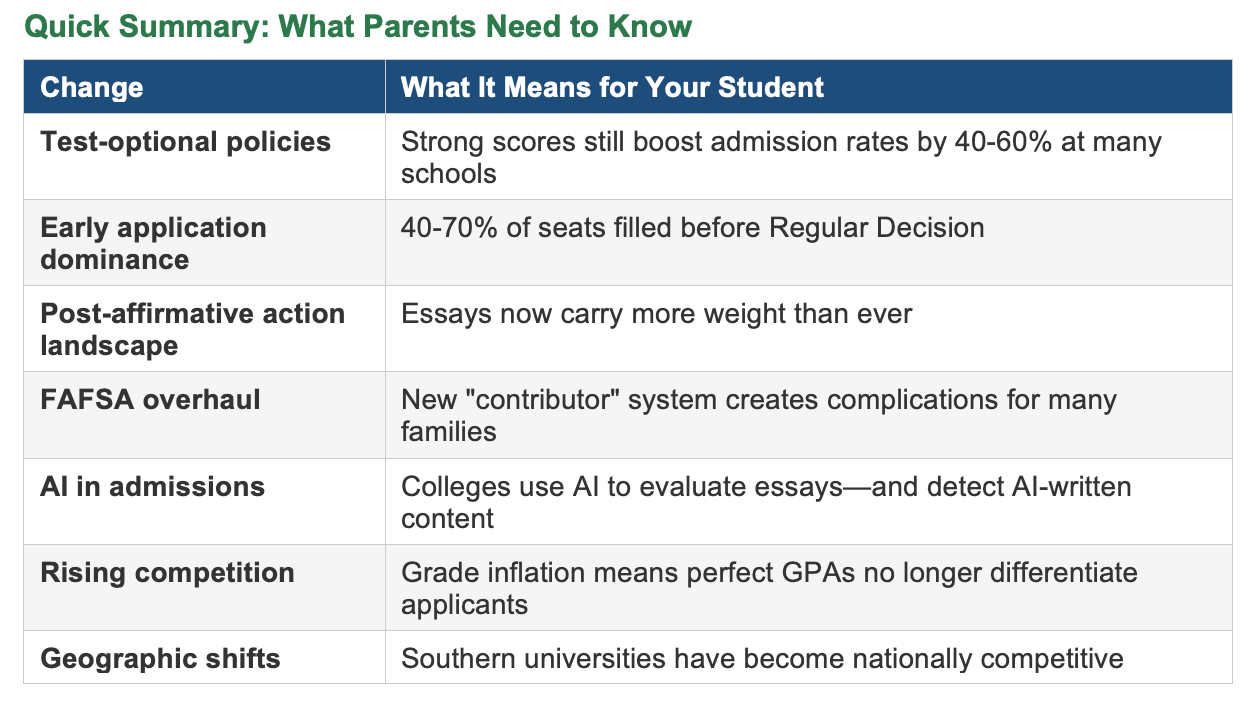
Why Are College Admissions Rules Changing So Often?
If you're a parent helping your child prepare for college, you've noticed something frustrating: the advice that worked five years ago no longer applies.
Test scores were "optional." Now they matter again. Regular Decision was standard. Now Early Decision fills most seats. Legacy was an advantage. Now it's nearly neutral at many schools.
The reason: Colleges are responding to unprecedented application volume, legal rulings, financial pressures, and technological change—all at once. The landscape shifts because institutions are constantly adapting their strategies.
The good news? Families who understand current trends have a significant advantage over those operating on outdated assumptions.
This guide breaks down the seven biggest changes affecting college admissions in 2026—with specific strategies your family can use starting today.
Is Test-Optional Still a Good Idea in 2026?
The short answer: It depends entirely on your student's scores and target schools.
For years, parents heard standardized tests were becoming obsolete. The 2025-2026 data tells a different story.

Why the disparity? With grade inflation making 4.0+ GPAs standard, test scores have become one of the few consistent signals colleges use to verify academic strength.
Schools Returning to Required Testing
• University of Alabama System: Requiring scores for all applicants by 2027-28
• Dartmouth, Yale, Brown, MIT: Already reinstated testing requirements
• Many flagship state universities: Moving toward required testing for certain applicants
Real Example: When "Optional" Wasn't Really Optional
Maya had a 4.0 GPA and strong extracurriculars. Assuming tests were truly optional, her family skipped SAT prep. She applied without scores and was waitlisted at three universities where her GPA alone seemed competitive—while students with similar GPAs but strong test scores were admitted.
How Stepping Stones Helps With Test-Optional Admissions
At Stepping Stones College Educational Advisors, we analyze each student's profile and target schools to determine whether submitting scores strengthens or weakens their application. We create customized test preparation timelines for students who benefit from testing and strengthen other application components for those who don't.
Why Are College Acceptance Rates So Low?
Acceptance rates reflect application volume, not just institutional selectivity. Students are applying to more schools than ever, which drives down admission percentages even when the number of enrolled students remains stable.
The Early Application Advantage Is Now Essential
Many selective colleges fill 40-70% of their freshman class during Early Action and Early Decision rounds:
• Early admit rates run 2-4x higher than Regular Decision at many schools
• Students applying in November face acceptance rates double or triple January applicants
The Trade-Off Families Must Understand
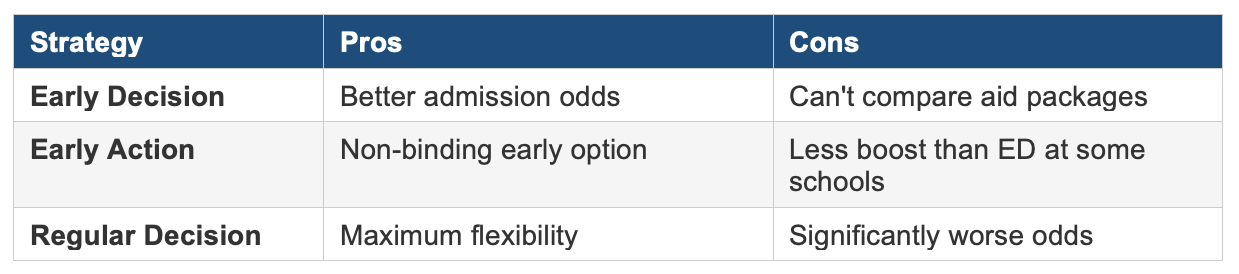
Early Decision is binding—accepted students must attend regardless of financial aid outcomes. This creates a difficult choice:
Real Example: The Cost of Waiting
David planned to perfect his application and submit Regular Decision in January. Students with similar profiles who applied Early Decision in November were admitted at 45%. David was rejected in a Regular Decision round where acceptance dropped to 15%.
How Stepping Stones Helps With Application Timing
We develop timeline strategies balancing competitive positioning with financial realities—helping families identify genuine first-choice schools for Early Decision, strong Early Action options, and Regular Decision approaches for those who need to compare aid packages.
How Important Is GPA and Course Rigor in College Admissions?
Course rigor matters as much as—and sometimes more than—GPA itself.
Admissions officers evaluate transcripts in context. A 3.7 GPA in the most challenging courses available often carries more weight than a 4.0 in standard-level classes.
What Colleges Actually Evaluate
According to the National Association for College Admission Counseling (NACAC), academic factors remain the strongest predictors of admission:
1. Rigor of curriculum — Did the student challenge themselves?
2. GPA in academic courses — Performance in core subjects
3. Overall GPA — The complete picture
4. Test scores (when submitted) — Verification of academic strength
The Grade Inflation Problem
Weighted GPAs above 4.0 are now standard, not exceptional. When thousands of applicants present near-perfect transcripts, grades alone can't differentiate candidates. This is precisely why essays, activities, and demonstrated depth have become more important.
How Stepping Stones Helps With Academic Planning
We work with families starting in 9th and 10th grade to ensure students take appropriately challenging courses while maintaining strong performance—building transcripts that demonstrate both rigor and success.
Do College Essays Matter More Than Grades?
Essays don't matter more than grades—but they've become the primary way students differentiate themselves in a pool of academically qualified applicants.
Why Essays Carry More Weight in 2026
Two major shifts have elevated essay importance:
5. The end of race-conscious admissions: Students from underrepresented backgrounds must now communicate their experiences through narrative rather than demographic checkboxes.
6. AI detection concerns: Colleges are increasingly using AI to evaluate essays—and to detect AI-written content. Authenticity matters more than polish.
What Admissions Officers Look For
Cornell researchers found AI-generated essays are "highly generic and easy to distinguish from human writing." Admissions readers seek:
• Authentic voice — Writing that sounds like a specific 17-year-old, not a professional
• Specific details — Concrete moments, not abstract claims
• Genuine reflection — Real insight, not performed wisdom
Real Example: Two Students, Different Outcomes
Two first-generation Americans from Vietnamese immigrant families applied to the same university. Student A wrote generically about "overcoming challenges." Student B described translating legal documents for her parents since age 12 and how it shaped her interest in immigration law. Student B was admitted. Student A was not.
How Stepping Stones Helps With College Essays
Your essay must sound like you. We help students develop authentic voice through structured brainstorming and feedback that refines without homogenizing—producing work that is genuinely theirs.
How Does Financial Aid Affect College Admissions Decisions?
Financial aid planning must begin before senior year—and the FAFSA overhaul has created new complications families need to understand.
The 2024-25 FAFSA Disaster (and What's Different Now)
The 2024-25 launch opened three months late with widespread glitches, causing a 9% drop in first-time applications. The 2026-27 FAFSA launched in September 2025—the earliest in program history.
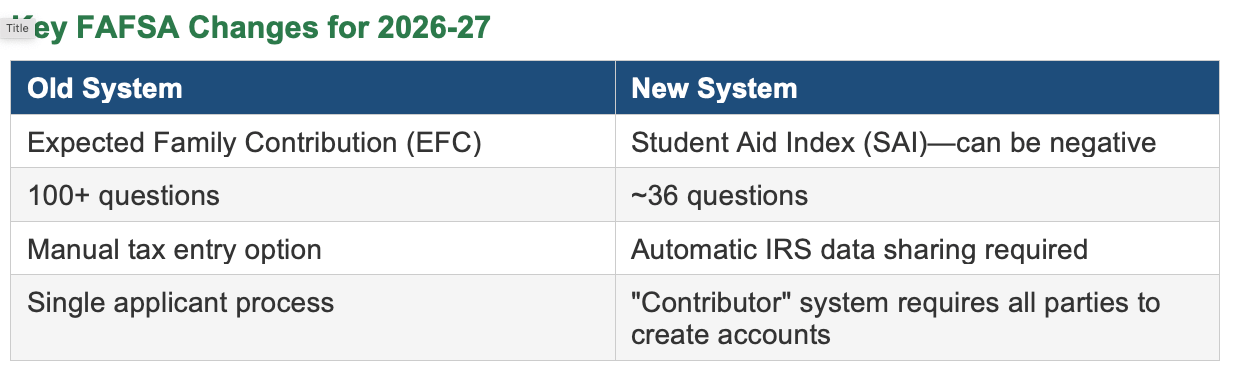
Key FAFSA Changes for 2026-27
The Hidden Complication
The new contributor requirement means anyone providing financial information—including non-custodial parents—must create their own account and provide consent. For families with complicated situations, this creates unexpected delays.
Real Example: When Family Situations Get Complicated
The Johnson family completed FAFSA easily for their oldest child. For their younger son, the contributor requirement meant his non-custodial father—with whom he had no relationship—needed to create an account. They nearly missed their first-choice school's priority deadline.
How Stepping Stones Helps With Financial Aid
We guide families through the complete financial aid process: understanding how the new formula treats your situation, identifying schools likely to offer strong aid, navigating contributor requirements, and meeting priority deadlines.
How Can Families Prepare for College Admissions in 2026?
The families who navigate this landscape successfully start early and stay informed. Here's what matters at each stage.
9th-10th Grade: Build the Foundation
☐ Select appropriately challenging courses
☐ Explore genuine interests—not what you think colleges want
☐ Begin building depth in 1-2 meaningful activities
☐ Start foundational test prep skills
☐ Have early conversations about college priorities and finances
11th Grade: Develop Your Strategy
☐ Create focused activity plan highlighting depth over breadth
☐ Finalize testing plan: choose test, lock in dates, commit to prep
☐ Research colleges based on fit, not just reputation
☐ Begin essay brainstorming in spring
☐ Have honest family conversations about geographic and values preferences
12th Grade: Execute Your Plan
☐ Develop Early Action/Early Decision strategy by September
☐ Complete essays by October for early rounds
☐ Build balanced college list with genuine options at every selectivity level
☐ Submit FAFSA immediately when it opens
☐ Maintain academic performance through first semester
☐ Prepare for interviews if offered
Key Takeaways for College Admissions in 2026
1. Test-optional admissions require school-specific strategy. Strong scores still significantly boost admission rates at most selective institutions.
2. Acceptance rates reflect application volume, not just competitiveness. Early applications have become essential, not optional.
3. Course rigor matters as much as GPA. Colleges evaluate transcripts in context.
4. Essays and activities play a larger role than ever before. They're the primary differentiator among academically qualified applicants.
5. Financial aid planning must begin before senior year. The new FAFSA creates complications families should anticipate.
6. Personalized guidance helps families avoid costly mistakes. The complexity of today's landscape makes expert support more valuable than ever.
Frequently Asked Questions About College Admissions in 2026
Is college admissions harder in 2026 than previous years?
College admissions is more competitive due to higher application volume, but success depends on strategy, fit, and preparation—not just grades or test scores. Families who understand current trends and plan accordingly can navigate the process successfully.
Should students still take the SAT or ACT in 2026?
Yes. Even at test-optional schools, strong scores can strengthen applications and increase scholarship opportunities. The decision to submit should be strategic and school-specific.
When should families start preparing for college admissions?
Ideally by 9th or 10th grade, when course selection, extracurricular involvement, and academic planning begin to matter. However, students at any stage can benefit from understanding current trends and adjusting their approach.
How can college advisors help students stand out?
Advisors help students build balanced college lists, tell authentic stories through essays, make informed decisions about testing and coursework, navigate financial aid, and develop application strategies aligned with their goals and circumstances.
What's the biggest mistake families make in college admissions?
Waiting too long to get serious—and operating on outdated assumptions. The strategies that worked five years ago don't apply today. Families who understand current realities and plan accordingly have significant advantages.
How much do extracurricular activities matter?
Quality matters far more than quantity. NACAC data shows colleges prefer students demonstrating depth and long-term commitment in meaningful areas over those spread thin across many activities.
🎓 Need Help Navigating College Admissions in 2026?
Stepping Stones College Educational Advisors provides personalized college planning, application strategy, essay guidance, and financial aid support for families nationwide.
What We Offer
• Personalized Strategic Planning — Customized roadmaps based on your student's unique profile, goals, and circumstances
• Application Development — College list building, essay coaching, activity presentation, interview preparation
• Financial Aid Guidance — FAFSA navigation, aid package analysis, scholarship strategy
• Ongoing Support — Regular check-ins from 9th grade through enrollment decisions
Schedule a Consultation Today
Create a clear, confident path to college. Our experienced counselors stay current on every policy shift so you don't have to figure it out alone.
📞 +1 (714) 400-2497
📧 connect@steppingstonesadvisors.come
🌐 www.steppingstonesadvisors.com
─────────────────────────────────────────
Stepping Stones College Educational Advisors
Guiding families through the changing landscape of college admissions
Published February 2026. College admissions policies continue to evolve.
For current guidance specific to your student's situation, schedule a consultation with our team.